
Nutrition labelling became mandatory in Canada in 2007 on all prepackaged foods. Since then, nutrition and ingredient information has been listed on the food label. They have been designed to be easy to find, simple to read and to allow Canadians to make informed food choices.
What information is on a food label?
By law, all prepackaged foods must have the following:
- A Nutrition Facts table
- An ingredient list
They may also have nutrition claims but they are optional.
The Nutrition Facts table
The Nutrition Facts table is meant to allow you to:
- learn about the calories and nutrients the item contains
- make it easy to compare similar foods
- look for foods that have a little or a lot of a certain nutrient
- select foods for special diets
It must include the serving size, calories, % Daily Value and 13 core nutrients (fat, saturated fat, trans fat, cholesterol, sodium, carbohydrate, fibre, sugars, protein, vitamin A, vitamin C, calcium and iron). The format is consistent across all food products to allow for easy comparison between different items.
The information in the Nutrition Facts table is based on the serving size that is listed. It is important to compare this to the actual amount that you eat.
How to use the Nutrition Facts table
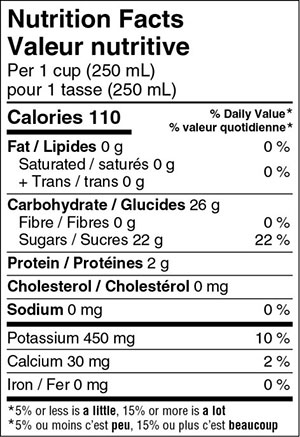
Step 1: Look at the serving size
The serving size is at the top of the Nutrition Facts table. All the information in the Nutrition Facts table is based on this amount. Compare this to the amount of food you actually eat. For example, if the serving size listed is 1 cup but you ate 2 cups you need to double all the amounts listed.
Step 2: Look at the calories
The amount of calories is based on the serving size. If you usually have more than the serving size, your intake of calories will be higher than what is listed. If you eat less than the serving size, your intake will be lower.
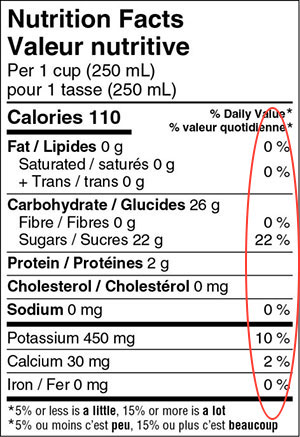
Step 3: Look at the percent daily value (% DV)
The percent daily value (% DV) shows you if a food has a little or a lot of a nutrient.
The % DV is meant to act as a benchmark to determine if that food is high or low in a certain nutrient.
You can use it to compare the nutrient content of different foods.
Step 4: Try to get more of these nutrients
- Fibre, vitamin A, vitamin C, iron, calcium
Step 5 : Try to get less of these nutrients
- Fat, saturated fat, trans fat, sodium, cholesterol
If you were trying to decide between two cereals to get more fibre you could use the % DV.
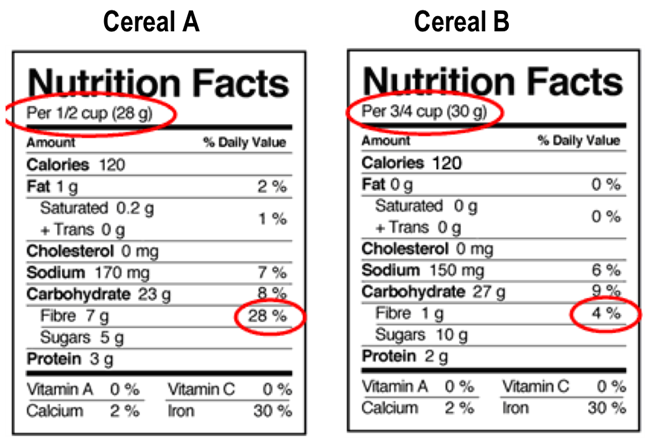
In this example, cereal A is a better choice than cereal B because it has 28% DV for fibre compared to 4% DV.
Using the Nutrition Facts table to make healthy choices
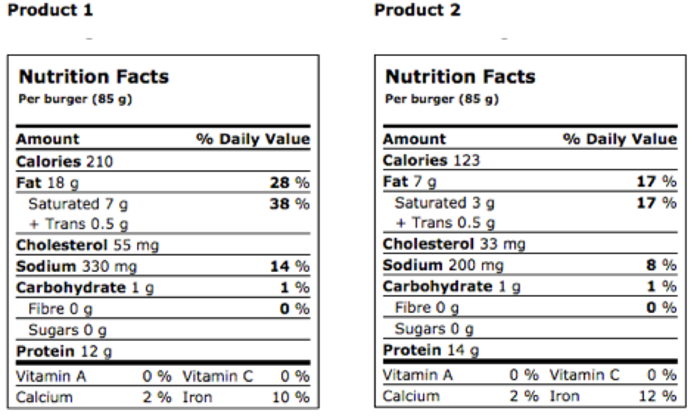
By comparing the two labels we can gain a better sense of which product is a healthier choice.
Step 1 - Serving size: The information on both packages refers to one burger. They both weigh the same.
Step 2 - Calories: Product 1 has 210 calories per serving and product 2 has 123 calories per serving.
Step 3 - Look at the % Daily Value: Do a quick scan and see what nutrients each product is high in and low in.
Step 4: Nutrients you may want more of: These include fibre, vitamin A, vitamin C, iron and calcium.
Step 5: Nutrients that you may want less of: These include fat, saturated fat, trans fat, sodium and cholesterol.
Product 1 has a higher % DV in fat, saturated fat and sodium compared to product 2. Product 2 is the healthier choice.
Sometimes it is not as clear which food is the healthier choice. For example, one product might be low in fat but high in salt while another one may be high in fat but low in salt. The one you choose will depend on your specific needs and requirements. A dietitian can help you determine what to focus on and the amounts you should aim for.
The ingredient list
The ingredient list includes all the ingredients that are in the product. They are listed in order by weight with the heaviest ingredient listed first and the lightest ingredient listed last.
The ingredient list is useful to see what the product is made of. This can be very helpful if you have a food allergy or intolerance and need to avoid certain foods.
Nutrition claims
Nutrition claims include nutrient content claims and health claims. Both are optional on food labels.
What are nutrient content claims?
A nutrient content claim indicates that the food has a certain amount of a specific nutrient. Example: High in vitamin C.
When you want to increase the amount of a certain nutrient look for words like:
- Source (for example, “source of calcium”)
- High or good source (for example, “high in fibre”)
- Very high or excellent source (for example, “excellent source of vitamin A”)
When you want to decrease the amount of certain nutrients looks for words like:
- Free (for example, “sugar free”)
- Low (for example, “low in saturated fat”)
- Reduced (for example, “calorie reduced”)
A complete list of nutrient content claims and their meanings can be found at Nutrient content claims: what they mean.
What are health claims?
A health claim is a statement that mentions certain nutrients and their role in preventing disease. Example: A healthy diet low in saturated and trans fats may reduce the risk of heart disease. (Name of food item) is low in saturated and trans fats.
A complete list of health claims and their meanings can be found at Health claims: what they mean.
Are all foods required to have a food label?
No. There are some foods that do not required a label. These include:
- fresh fruits and vegetables
- raw meat, poultry, fish and seafood
- foods prepared or processed at the store (bakery items, sausages, salads)
- foods that contain very few nutrients (tea, coffee, spices)
- alcohol
Restaurants and food service businesses are also not required to have a Nutrition Facts table attached to their products.
Bottom line
The information on the food label is to help Canadians make informed decisions about the foods they eat. Use this information in combination with Canada’s Food Guide to make informed choices on healthy eating.
Did you know?
Many grocery stores have dietitians who are available to help customers with cooking, reading labels and meal prep ideas. Ask your grocery store if they have a dietitian on staff.
You may also be interested in:
Canada’s Food Guide
Last Update – July 6, 2023